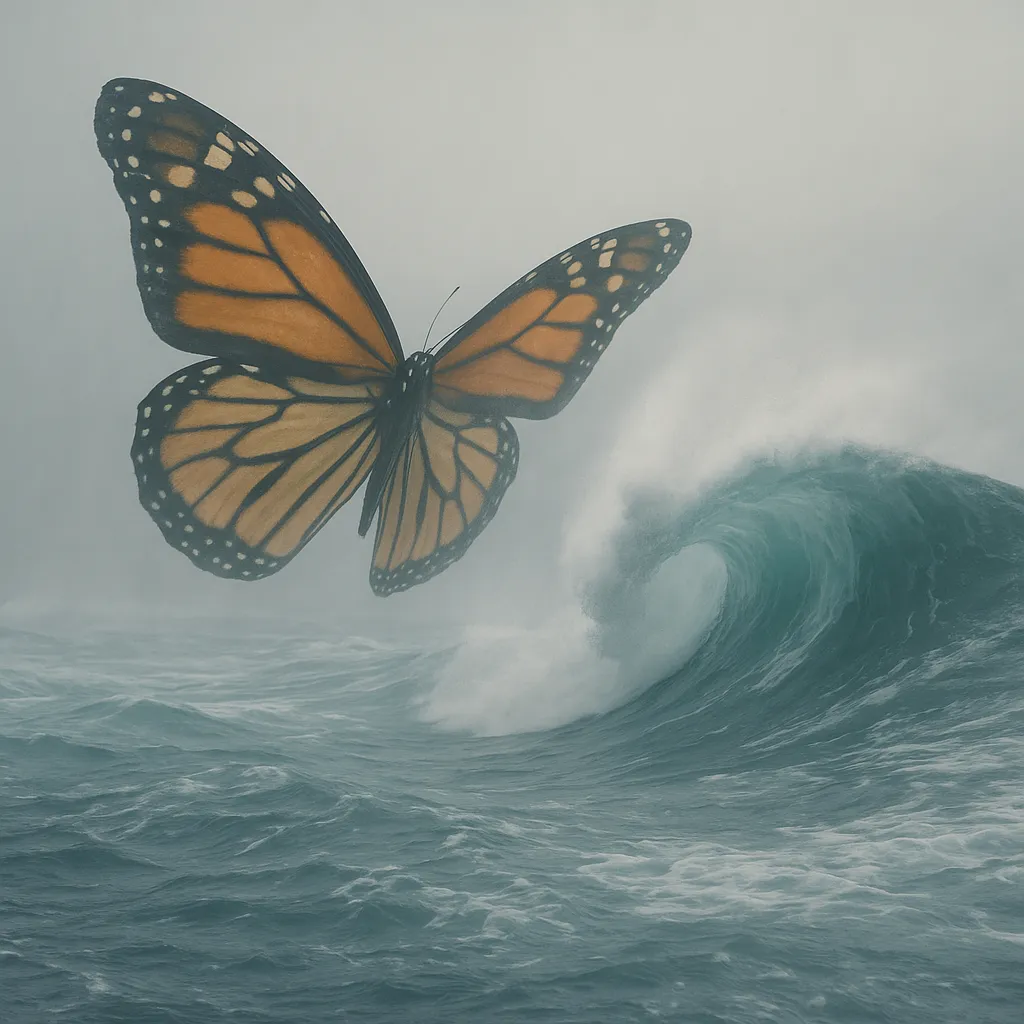
The Butterfly Ocean
Somewhere beyond the horizon, a single breath of wind lifts a patch of water. The wave that forms seems small at first, a passing rhythm on a calm day. Yet that motion, joined by thousands of others, will shape an entire coastline before it rests again. The ocean, it seems, is built on the quiet power of small beginnings.
In the 1960s, a meteorologist named Edward Lorenz discovered that when he rounded a single number in his weather model, the forecast changed completely. It was a simple mistake, but it revealed something profound: tiny changes can have enormous effects. Scientists call it sensitive dependence on initial conditions. The smallest nudge, a change in temperature, a wingbeat, a flick of current, can reshape entire systems.
The ocean is full of these moments: turbulence, feedback, self-correction. It is a living model of chaos and order coexisting. A shift in temperature alters a current, a current shifts the wind, and the wind calls up new waves. Coral reefs grow and fade with the smallest changes in sunlight. A single storm, born from a whisper of heat, can rewrite the map of a shoreline. What looks like chaos is actually a pattern of endless cause and effect, each moment carrying the memory of the last.
Chaos theory does not mean disorder. It means hidden structure, a rhythm so complex that no two repetitions ever align. The ocean follows this dance with perfect honesty. Every crest and hollow, every tide and swirl, obeys its own delicate rules. And within those rules, the sea still finds room for surprise.
Perhaps we live the same way. A word spoken, a choice delayed, a kindness offered at the right time; each sends out a small current that touches others beyond our sight. We rarely know how far our actions travel, or what shore they finally reach. But like the ocean, we are moved by unseen connections.
The next time you stand at the edge of the water, watch the surface change. Each ripple is a beginning, each wave a reminder that small things matter. The butterfly ocean is all around us, teaching that from the smallest breath, the world begins again.
Sources
Lorenz, Edward N. Deterministic Nonperiodic Flow. Journal of the Atmospheric Sciences, vol. 20, no. 2, 1963, pp. 130–141.
Gleick, James. Chaos: Making a New Science. Viking, 1987.
Capra, Fritjof. The Tao of Physics. Shambhala Publications, 1975.
Heisenberg, Werner. Über den anschaulichen Inhalt der quantentheoretischen Kinematik und Mechanik. Zeitschrift für Physik, 1927.
